Sunday, June 18, 2017

The Lost Heritage Houses of Baliwag, Bulacan


As early as 1800, Baliwag, Bulacan had been a center of commerce and trade in Bulacan. The Glorieta, one of the largest squares in Bulacan, hosted weekly market fairs where products from Manila and other places were traded. Baliwag’s farm products included indigo, sugar cane, rice and corn. Baliwagenyos also indulged in weaving fabrics, spinning cottons, extracting sesame oil, milling sugar, weaving hats, among others. The industriousness of its citizens and the town’s strategic location brought in unprecedented progress.

Thus, by 1850’s Baliwag, became one of the most prosperous towns in the Province of Bulacan. It boasted of beautiful mansions dotting its major thoroughfares, some of which have beautiful gardens and orchards. These mansions were owned by the town’s wealthy mestizo citizens. These houses were generally classified under Spanish colonial architecture which continued to be in vogue even until the turn of the 20th century.

In time, however, many of Baliwag’s beautiful mansions fell into a state of disrepair and neglect by its present owners. Oftentimes, these mansions were converted into commercial stores because of their prime locations. The grand Rustia Residence, for instance, now housed a beauty parlor. A shoe repair shop clinging on its side is a reminder that its glory is now a distant past. Many other Baliwag mansions suffered the same fate. In 2006-2007, two (2) of them were sold, dismantled and transferred to Las Casas Filipinas de Acuzar, a Museum Resort in Bagac, Bataan. For Baliwag, Bulacan, they are now lost beyond recovery. The descriptions of the two houses are as follows:

Casa Baliuag I: The Residence of Kapitan Fernando Vergel de Dios

In Barangay Poblacion, at the corner of Burgos St., just across the old San Agustin Church in Baliuag, Bulacan, once stood a proud mansion - the residence of Kapitan Fernando Vergel de Dios. Built in 1898, the mansion was of Bahay na Bato architecture - a sturdy and elegant version of Bahay Kubo with thick adobe ground floor walls and windows of large glass panes. It once served as the Municipal Hall of Baliuag, Bulacan in the 1950s.

The mansion was a landmark in Baliwag, Bulacan. It had an elaborate adobe facade decorated here and there with floral motifs, which was in vogue during those times. The intricate wood carvings at its bandejas (wood sidings) perfected its highly floral motif. The lines of the house are decisive and contrived, creating an elegantly proportioned piece of architecture. The ground floor is enclosed with thick adobe walls that terminate in rows of horizontal moldings that seemed to distinctly delineate the wooden second floor.

The zaguan, or the ground floor, had bodegas and spaces for carriages and processional andas and carrozas. The walls of the zaguan are punctured with symmetrically distributed arched doors in harmony with the generous window openings on the upper floor. The doors are decorated with adobe-sculpted pots overflowing with flowers. The front part of the zaguan was also called luwasan because it was where Baliwagenyos waited for their ride to Manila. And taking advantage of the many people who stood in front of their house, the owners converted the zaguan into a photo studio and a post office.

The second floor of the house presents a tasteful ensemble of huge panels of sliding windows of wood-framed glass panes; ventanillas protected by wrought iron break the monotony. On the far left of the house is a porte cochere, a portico-like structure at the secondary entry to the house where a horse or a carriage can drive in so that the owners can enter the building protected from the weather. Above the porte cochere is a balcon enclosed by railings of terracotta balusters. Almost unique to the Casa Baliuag I, were the life-size wooden sculptures of Filipino women carrying a basket on their heads. These sculptures decorated the porch as fake posts.

In time, however, the mansion became a victim of neglect of its owners. Some of its architectural details were sold, lost or stolen. The mansion’s contents were gradually lost. Fortunately, before it was totally gone, it was sold to Las Casas Filipinas de Acuzar and was dismantled and moved to Bagac, Bataan in 2007.
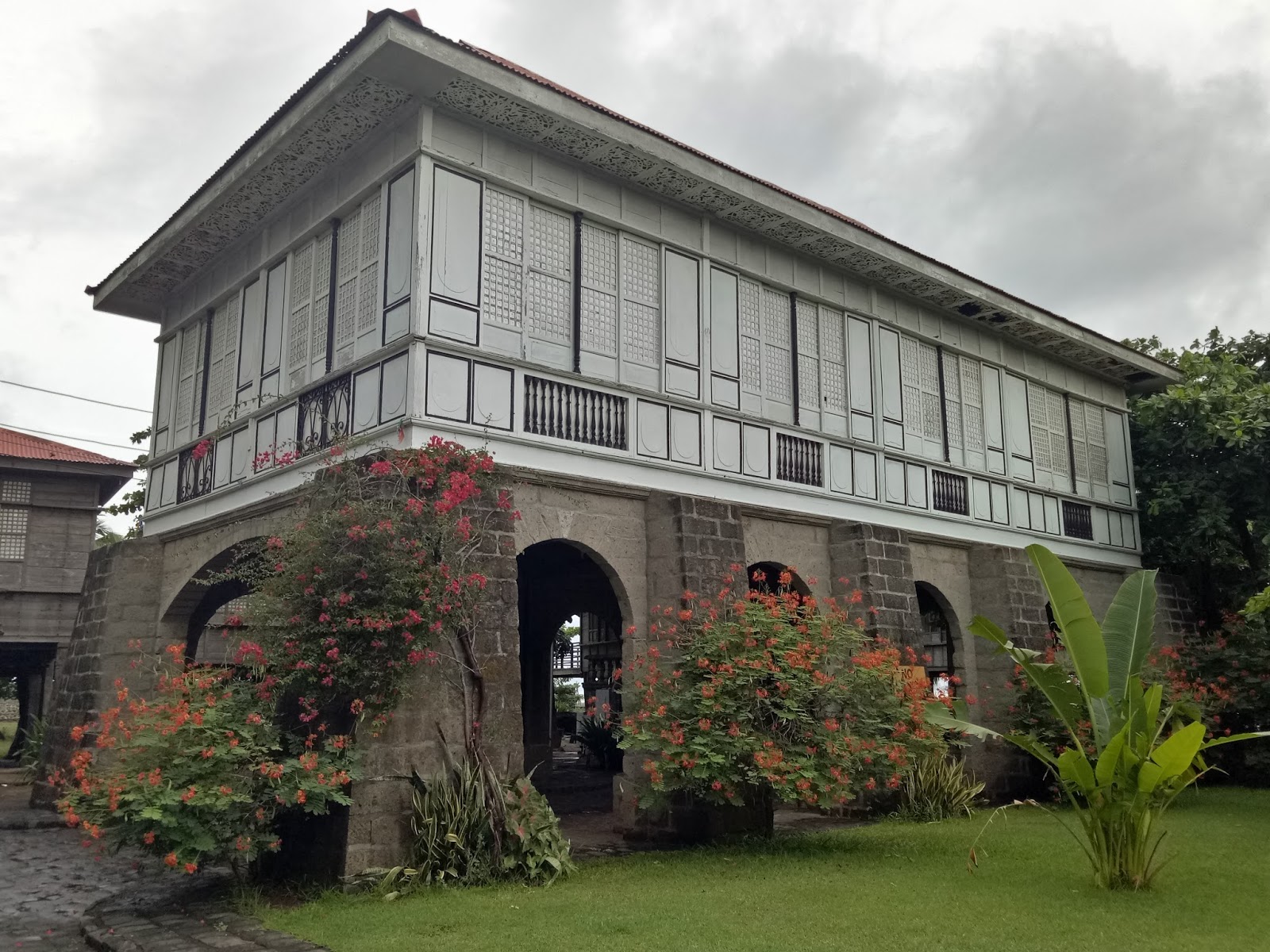


Casa Baliuag II: “Iglesia Ni Cristo House”

Casa Baliuag II’s original owner is still to be ascertained. The house was originally located within the compound of the Iglesia Ni Cristo Church in Baliwag Bulacan. As such, the house was used as a function hall by the members of the Iglesia Ni Cristo. It was dismantled, transported and reconstructed at Las Casas Filipinas de Acuzar in Bagac, Bataan in 2006.

For most bahay na bato, the zaguan, or the ground floor space of the house, is usually used as a general storage area for carriages, carrozas, grain harvests and old furniture, among others. It usually is accessed through a large doorway with a double-panel door. It is usually enclosed with almost a meter-thick walls which elicit feelings of structural stability. With its thick walls, the zaguans are generally dank and gloomy.

But Casa Baliuag II defies all foregoing stereotyping. Its zaguan is just a rectangular open space with two large arched doorways at both ends. From the outside, it looked like a vaulted carriageway with a rectangular house on top. The zaguan’s adobe walls were punctured with symmetrically distributed arched doorways in harmony with the generous window openings on the second floor. Thinner Adobe walls were buttressed with thick adobe posts giving sense of stability. The zaguan had neither doors nor windows, just open arched doorways. Caruajes and carrozas may enter freely at the entrance and may drove straight out at the rear end of the house. Thus, it looked like an train station, rather than a house.

The entrance to the house is not through the zaguan but at the right said of the house. Wide balustraded stone steps with tile flooring led up to a landing. From which, a narrower wooden steps protected with wood handrails and balusters of the same design as those in the ventanillas led up to the main door of the second floor. The second floor had a complement of caida, antesala and sala, comedor, bedrooms and kitchen.

The grandeur of this bahay na bato comes from its proportion and the exquisite wood detailing of the interiors. It is a wonderland of architectural details from the walls to the ceilings. Grand in scale, the elements of lightness, translucence, efficient ventilation and spaciousness without extensive physical space. The principles of tropical architecture are embedded in this house in an almost effortless manner.

The World’s Gains

These two (2) houses are now well-preserved in Las Casas Filipinas de Acuzar. Their uniqueness as dwellings and as objects of history are now appreciated by tourists, both Filipinos and foreigners. For sure, these houses’ lifespan would be longer in Bagac, Bataan than if they were in Baliwag, Bulacan. They are Baliwag’s lost, but the world’s gains.

Monday, June 12, 2017

Baliwag, Bulacan Strengthens Katarungang Pambarangay


Participants of the Second Day, May 19, 2017.

The Municipality of Baliwag, Bulacan (LGU-Baliwag), the Department of Interior and Local Government of Baliwag (DILG-Baliwag), the Association of Barangay Captains (ABC) and Baliwag Polytechnic College (BTECH) collaborated for the conduct of seminar-workshop on Katarungang Pambarngay (Barangay Justice). The seminar-workshop was held on May 18 and 19, 2017 at the Conference Room, Baliwag Water District. The activity aims to train members of Lupon Tagapamayapa for speedy, non-adversarial and proper dispensation of justice at the Barangay level.

The seminar-workshop was participated in by some members of the Pangkat Tagapagkasundo of all twenty seven (27) Barangays of LGU-Baliwag. The first day, May 18, 2017, was participated by Barangays Bagong Nayon, Barangca, Calantipay, Catulinan, Concepcion, Hinukay, Makinabang, Matangtubig, Pagala, Paitan, Piel, Pinagbarilan and Poblacion. While the second day, May 19, 2017, was participated by Barangays Sabang, San Jose, San Roque, Santa Barbara, Santo Cristo, Santo Niño, Subic, Sulivan, Tangos, Tarcan, Tiaong, Tibag, Tilapayong and Virgen de las Flores.       

Mr. Gedeon G. Gamboa, a social science faculty of Mabalacat City College, served as a resource speaker and guest trainer. ABC President, Councilor Luciano Robes shared his own experiences and best practices as chair, Pangkat Tagapagkasundo.

Mr. Jayfie P. Nasarro of DILG-Baliwag gave a comprehensive discussion on Katarungang Pambarangay. He also showed video clips of actual conciliation activities. Mr. Nasarro also served as a Resource Person during the open forum.

Atty. Robert John I. Donesa, BTECH President, discussed on the civil and criminal jurisdictions of Katarungang Pambarangay. He also facilitated the workshops where actual and illustrative barangay cases were tackled.

The Seminar-Workshop on Katarungang Pambarangay is part of the Barangay Summit - an all year round series of LGU-Baliwag sponsored activities to engage and empower the Barangays.

The Seminar-Workshop Coordinators from BTECH with Mr. Jayfie P. Nasarro of DILG- Baliwag  
The participants of the first day, May 18, 2017.


Atty. Robert John I. Donesa, BTECH President, facilitated the Seminar-Workshop

Mr. Jayfie P. Nasarro of DILG-Baliwag answers queries from the participants. 

Sunday, May 14, 2017

A Communion of Augustinian Saints

The Parish of Saint Augustine, Baliwag, Bulacan held the 1st Baliuag Augustinian Exhibit on May 6-13, 2017 at the Parish Hall of Saint Augustine Church. The exhibit showcased the images of Augustinian saints and blessed owned by devout families in Baliwag, Bulacan. The exhibit is one of the highlights of Pistang Bayan 2017.

San Alipio de Tagaste: Obispo, Discipulo y Companero de San Agustin. Pamilya Rodriguez.

San Juan Stone de Canterbury: Presbitero y Martir ng Pamilya Navoa

Beata Cristiana de San Croce: Virgen ng Pamilya Mercado-Santos


Beata Elena Valentini Cavalcanti de Udine: Viuda y Religiosa ng mga Pamilya Manalili at Simbulan 

Apostol San Pablo, Apostol de los Gentiles. Pamilya De Leon-Garcia.


San Antonio Abad: Fundador del Movimiento Eremitico ng Pamliya Ignacio


San Ambrosio de Milan: Obispo, Doctor de la Santa Iglesia, Teologo y Orador ng mga Pamilya Laya at Canoza 


San Alonso de Orozco: Musico y Escritor Mistico ng Pamilya Hernandez-Manuel


San Ezequiel Moreno y Diaz: Recoleto, Obispo de Pinara y Pasto ng Pamilya Peralta-Santos


Beata Julia de la Rena de Certaldo: Reclusa Virgen ng Pamilya Cruz

Santa Magdalena de Nagasaki, Recoleto, Virgen y Martir, Patrona de la Orden de los Agustinos Recoletos ng Pamilya Espiritu


Santa Clara de la Cruz de Montefalco: Virgen, Monja y Abadesa ng Pamilya Rodriguez-Tengco


Santa Rita de Casia: Abogada de Imposibles ng Pamilya Faustino


San Juan Gonzales de Sahagun: Confesor, Predicador, Presbitero y Ermitaño ng Pamilya Clarin

Nuestra Señora de la Regla: Patrona Personal de San Agustin ng Pamilya De Leon


Santo Tomas de Villanueva: Confesor, Arzobispo de Valencia, Padre de los Pobres ng Parokya ni San Agustin sa Pangangasiwa ng Pamilya Cunanan-Cruz


San Nicolas de Tolentino: Confesor, Presbitero, Mistico, Patron de las Almas del Purgatorio ng Pamilya Silvestre-Cortez

San Guillermo el Grande: Monje, Ermitaño de Maleval ng mga Pamilya Cabingao at De Guzman 


San Fulgencio de Ruspe: Obispo y Abad de Africa del Norte ng mga Pamilya Buñing at Cruz 


San Maximo de Gafsa: Monje y Martir ng mga Pamilya Villangca-Marcos at Santos


San Bonifacio de Gafsa: Diacono y Martir ng Pamilya Fernando-Ramos


San Liberato de Gafsa: Abad y Martir ng Pamilya Flores-Yabut


San Posidio de Calama: Obispo, Discipulo y Biografo de San Agustin ng Pamilya Juaiting


Nuestra Señora de la Salud ng mga Pamilya Taruc, Gutierrez at Ignacio


Ang Pagninilay sa Santisima Trinidad ng Pamilya Rodriguez-Tengco


Ang Pagpapakita ng Virgen ng Parokya ni San Agustin at Pamilya Rodriguez-Tengco.

Santo Niño de Cebu ng Pamilya Ortiz-Clarin

Saturday, May 13, 2017

Baliwag, Bulacan, Two Hundred Years Ago

A screenshot page of Aragon's work, Estados de la Población de Filipinas.   
In 1817-1818, Don Yldefonzo de Aragon, a Spanish colonel, traveled around the Philippines to look into and write about the conditions of the Philippine cities, towns and villages.

Among others, he traveled around Bulacan, interviewed local officials and residents and took as much notes as he can. His descriptions of Baliuag, and the rest of Bulacan appeared in his books: Estados de la Población de Filipinas Correspondiente a el Ano de 1818 and Descripción Geográfica y Topográfica de la Ysla de Luzon O Nueva Castilla con las Particulares de las Diez y Seis Provincias O Partidos que Comprehende. Both books were published in 1819.

According to Aragon, in 1818, about four-fifth of Baliuag’s population settled on the right side of the Baliuag River, and the remaining one-fifth lived on the left side. The town generally had plain terrain covered with trees. Relative to its surrounding towns, Baliuag is a little more than a quarter of a legua towards Pampanga, some three leguas to Candava and San Luis, one legua to Candava swamps and two-and-a-half to Apalit. A legua was a historical measure of length equivalent to 5,572.7 meters. Relative to other Bulacan towns, Baliuag is roughly a legua to San Rafael and a quarter of a legua to the Hacienda de Buenavista. Baliuag is one legua to Quingoa (now Plaridel), three-fourth of a legua to Pandi, two leguas to Bigaa via the farm lands.

The inhabitants of Baliuag were mostly farmers. They cultivated indigo, sugar cane, rice and corn. Other economic activities include weaving fabrics, spinning cottons, extracting sesame oil, milling sugar, weaving hats and other menial works.

In Baliuag, like most towns along Quingoa river, indigo is cultivated with success. Bulacan accumulated about 400 to 500 quintals of indigo paste annually, much of which came from Baliuag. That was equivalent to four thousand pots of indigo mud. Indigo was used for the dyeing blankets and other textiles.

In Bongas (now part of Bustos), a barrio of Baliuag, there were many quarries of dry stones of better quality than those of Meycauayan. Some dry stones were, although soft, still superior than those of Guadalupe.

While most of the inhabitants of Baliuag were farmers, the town ironically, lacked land resources for its farming people. As a consequence, Baliuag farmers occupied and farmed the vast fertile lands between Baliuag and Pinac de Candava, which belonged to the Province of Pampanga. This was especially so since there was no clear delineation of boundaries between the two provinces. Aragon also noted that there were lands between Baliuag and Pampanga where the people who do not recognize the law and do not submit to authorities take refuge.

Baliuag farmers cultivated the lands between their hometown and Candava Swamps in Pampanga.

Sunday, May 7, 2017

Throwback: Baliwag, Bulacan in 1850

Baliuag, Bulacan, circa 1945, photograph by John Tewell. 

In 1850, Frs. Manuel Buzeta and Felipe Bravo, both Augustinian Missionaries, published a detailed geographical dictionary entitled Diccionario Geográfico, Estadístico, Histórico de las Islas Filipinas. This encyclopedic work gathered together all available information relative to the physical, political, religious and socio-economic geography of the Philippines, its significant islands, provinces, cities, towns, missions, visitas and barrios as of 1850. Entries were presented alphabetically.

Diccionario Geográfico described Baliuag as town in the Province of Bulacan on the island of Luzon. Situated on a shady plain on the banks of the mighty Baliuag river, the town had a pleasant and healthy climate. It was bounded by the towns of San Luis and Candava of the Province of Pampanga to the north; by the towns of San Isidro, Calumpit and Apalit, Pampanga to the west; by the towns of Pandi, Quingua (now Plaridel) and San Isidro (now Pulilan) to the south; by the towns of Angat and San Rafael to the east. 

A Beautiful Town 

According to the Diccionario, Baliuag, Bulacan was founded in 1732. Back then, it had about 3,503 houses distributed along its wide and leveled streets. The town had a jail and a primary school which were maintained by the community. A large number of children attended the school. The town also had a beautifully built parish church under the patronage of Saint Augustine and which was served by an Augustinian priest. The parish was under the Archdiocese of Manila.

The town had a large square, one of the largest in the province. The square was where the weekly market days were held. These market days drew in a considerable crowd and products from the countryside. The square was also the terminus of avenues which lead to different directions towards the neighboring towns. 

Besides the church and the tribunal, there were a number of well-constructed luxurious houses made of stone owned by mestizos. They had magnificent gardens, tree-lined walkways, and orchards planted with fruit trees. They presented very pleasant and picturesque views.

Livelihood

Baliuag, Bulacan had a large farming population but with a limited land resources. Many farmers had to leave and cultivate lands of nearby towns like Candava. Baliuagenyos produced indigo and sugarcane, and extracted sesame oil. Local artisans made hats and cigarettes packs, spun cotton and wove clothes. Locally produced dyes gave excellent color to locally produced fabrics. These fabrics were well known in Manila for its equality and fineness of threads and for richness of colors.


Northeast of the Baliuag was an estate owned by the brothers of San Juan de Dios. Known as Hacienda de Buenavista, these lands were generally flat and fertilized by Baliwag river. It supplied Baliuag with rice, corn, sugarcane, indigo, sesame, all kinds of legumes, farinaceous roots, lots of fruits and several medicinal plants.

Baliuag's commerce extended not only to other towns of Bulacan, but also to those of the Pampanga and Manila. Mails arrived in Baliuag weekly. The town had a population of 21,017 souls and paid 2,137 in taxes.